Magnetically Coupled Birdcage Resonator
Performance of Magnetic Resonance Imaging (MRI) systems depends on signal-to-noise ratio provided by the radio-frequency (RF) coils of the scanner. In this work we explore the potential of boosting the imaging signal by focusing the magnetic field in the region of interest (the brain of a patient). The focusing is achieved by introducing a passive resonant structure around the patient’s head.
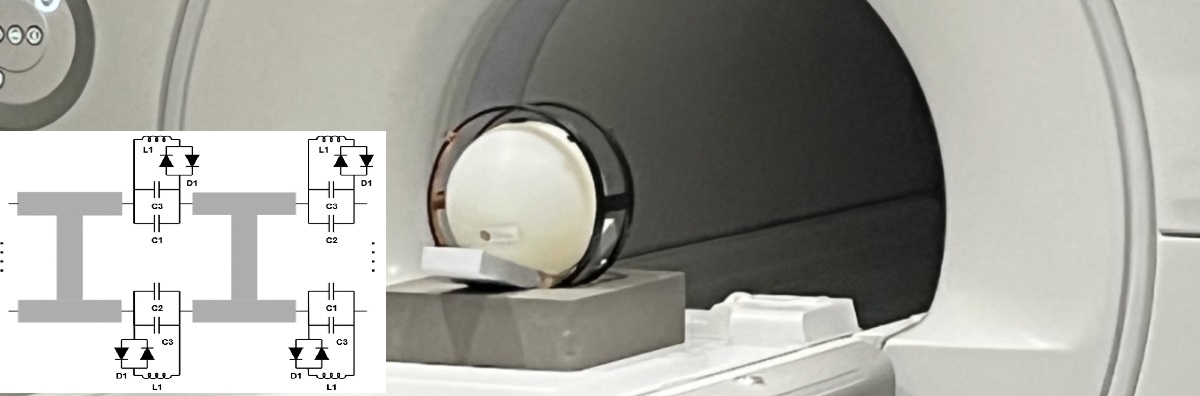
Motivation
MRI has revolutionized medical diagnostics by providing high-resolution images of internal body structures without
ionizing radiation. Central to MRI technology is the RF coil, which generates/senses the magnetic fields necessary for
imaging. Among various RF coil designs, the birdcage coil stands out for its efficacy in producing homogeneous RF fields.
Traditionally, MRI coils have been tethered to the MRI system through cumbersome cabling, limiting patient comfort and constraining imaging modalities. However, recent strides in wireless technology have spurred the development of wireless (passive), inductively coupled coils offering significant advantages in terms of flexibility, patient comfort, and imaging capabilities.
Design
Four-legged passive birdcage was chosen for realization here, which would be the lowest number of legs for providing a circular H-field. The passive birdcage couples inductively to the active coil and boosts the amplitude of the magnetic field, increasing SNR by over 16dB, as illustrated below.
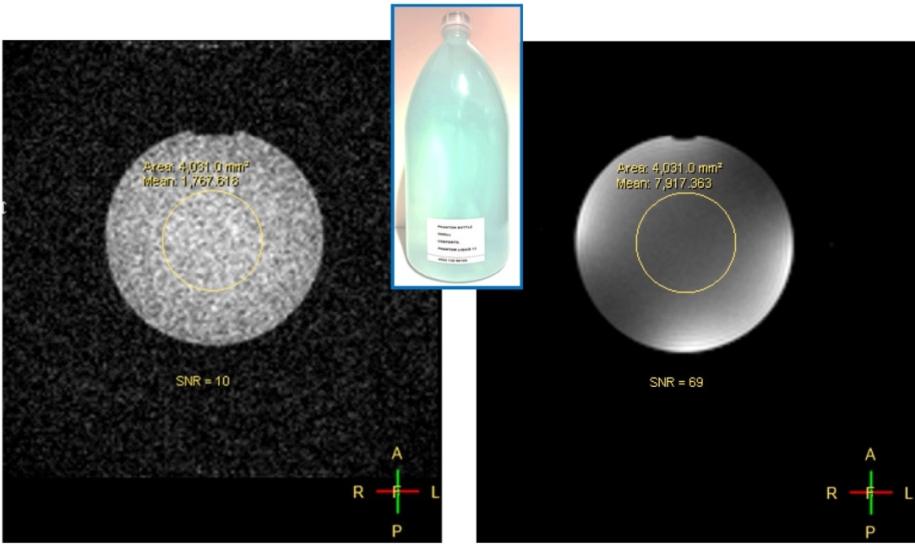
On the left is MRI image of the phantom without resonator and on the right is image with the resonator.
Further details
can be found in this .pdf: Preoceedings of EuMW2024.
SolidWorks Part file .SLDPRT of the 4-leg Birdcage coil holder for 3D printing.