Low Conversion Loss 94 GHz Doubler
The doubler is based on Indium Phosphide (InP) Double Heterojunction Bipolar Transistor (DHBT) process.
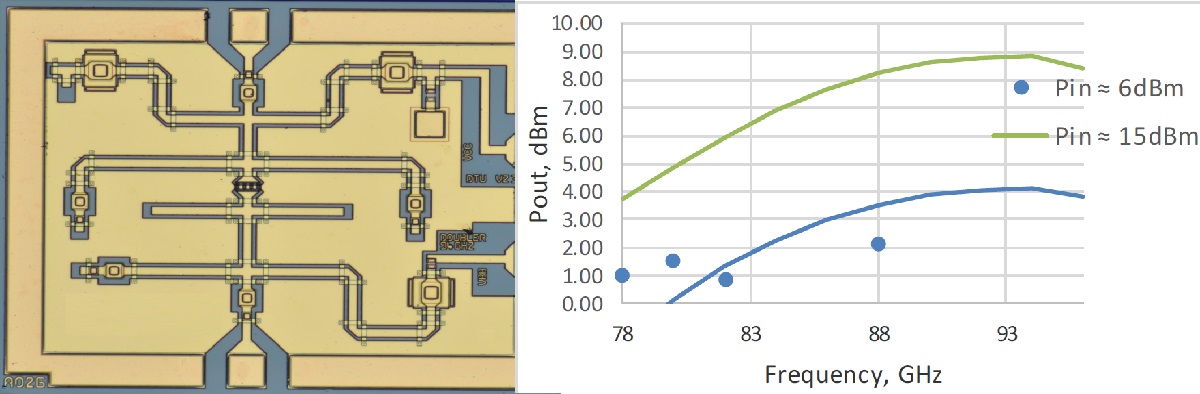
Motivation
The availability of fundamental tone sources in the millimeter-wave range is limited, which makes frequency multipliers an essential component in systems employing millimeter-wave signals.
Design
The circuit is designed for low insertion loss and fabricated in a high-speed InP DHBT circuit technology developed at III-V Lab. For optimum power conversion the input of the single 4-finger DHBT transistor is matched at the fundamental frequency while the output is matched at the second harmonic. The output circuit also suppresses the fundamental frequency signal in the load by presenting short-circuit to the output of the transistor at this frequency. The same is done at the input of the transistor for the second harmonic. The matching circuits are realized using open-circuited and short-circuited stubs. AC coupling MIM capacitors are used to provide RF ground for short-circuited stubs. The layout is based on coplanar waveguide (CPW) transmission lines.
For compact layout lengthy CPW had to be bent introducing discontinuities resulting in increase of the insertion loss of the circuit by several dB. To minimize discontinuity airbridges are used at transmission line junctions to suppress undesired slot mode excitation. Another challenge in CPW based layout is truncated ground plane, which is also significantly segmented by numerous stubs. Segmented ground plane with fragments comparable to wavelength will excite parasitic modes in the circuits degrading performance of the matching and filtering circuits. Analysis of these modes can only be performed by full-wave simulations, which dramatically complicates the layout development. For reference, the guided wavelength on implemented CPW is ≈ 1.4 mm at 94 GHz, which is comparable to the chip dimensions (1.35 mm × 1.05 mm). Therefore, parasitic modes should be carefully analyzed and suppressed.
Further details
can be found in this .pdf: DOI: 10.1109/INMMIC.2017.7927292